Quick Bite. A 4 minute read from Suna's doctors.
The signal was always there. The tool didn't exist.
A gastroenterologist on why gut sounds are sitting roughly where heart rate variability was twenty years ago.
 Dr Sam WithingtonGastroenterology Speciality Registrar and Suna's Gut Health Lead
4 min read. Updated .
Your gut makes noise all day and for a century we filed it under embarrassment. Doctors with stethoscopes were never able to read it, but microphones and software are starting to. The research is still early, and the interesting part is not diagnosis, it is watching your own patterns over months.
When I tell people I work for Suna, many of them have the same question. What on earth is the use of tracking the sounds my gut makes?
There's been an explosion in the use of consumer wearables, and people are finding new and exciting ways to make use of their own data. I personally track my sleep and my heart rate variability using a smartwatch, and I use that data to inform my incredibly mediocre running aspirations. I recently had a particularly unpleasant illness, and my heart rate variability, or HRV, absolutely tanked several days before I actually started to feel unwell. The watch knew before I did.
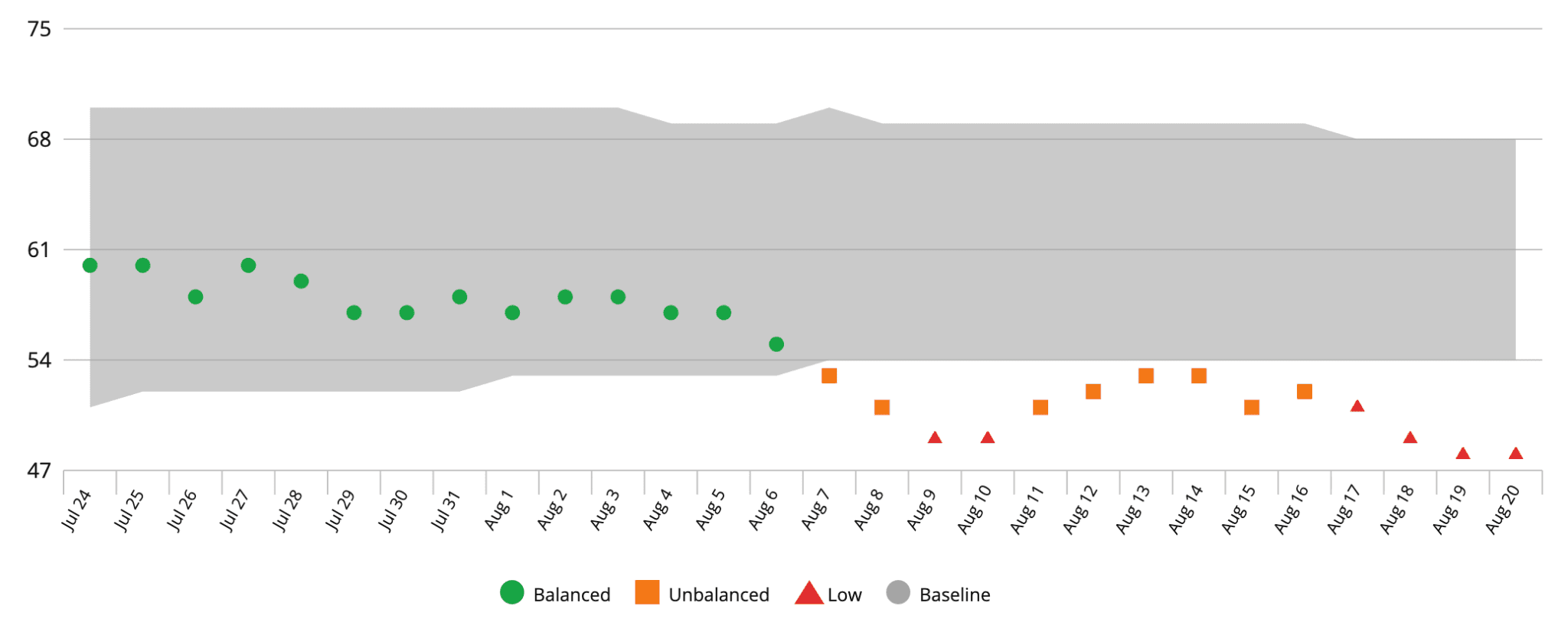
HRV is the variation in the gap between one heartbeat and the next. A healthy resting heart isn't a metronome. The gaps shift with the balance between the half of your nervous system that readies you for action and the half, mostly the vagus nerve, that handles rest, recovery and digestion. Well rested, the beats vary more. Run down, too many beers or coming down with something? They fall into line and HRV drops.
At medical school HRV was mentioned as a curiosity, and as a minor inconvenience that made more athletic people's heart tracings harder to interpret. Now it's a core part of how I, and a great many other people, keep an eye on how we're doing.
So what does this have to do with Suna and the gut? Well, first of all, Suna tracks your heart rate and HRV too. But in addition, it listens to the sounds your gut makes, and that's the bit people find odd. It's also the bit I find most interesting, because I think gut sound monitoring is sitting roughly where HRV was twenty years ago.
Your gut is a long muscular tube squeezing gas, liquid and food along its length, and bowel sounds are just the noise of it doing its job. They aren't random. Between meals the small bowel runs a housekeeping sweep called the migrating motor complex, and scientists at the University of Western Australia picked out six complete cycles in an eight hour fasting recording using nothing more than a cheap sensor held against a volunteer's abdomen by a stretchy belt. Traditionally, that needed a catheter passed through the nose into the small intestine. Nobody enjoys having one of those put in.
A confession on behalf of my profession
Doctors have been listening to bowel sounds for as long as there have been stethoscopes, and we are not very good at it. A 2014 study in the Journal of Surgical Education played recordings from healthy volunteers, patients with a bowel obstruction and patients recovering from surgery to 41 clinicians, from students to consultants. They got the right answer between 22 and 32 per cent of the time, and when the same person was played the same recording twice they agreed with themselves only about half the time. That doesn't mean bowel sounds are meaningless. It means a human with a stethoscope, listening for thirty seconds on a busy ward, is a poor way to measure them.
Record gut sound digitally and let a computer at it, though, and things fall out that no ear would catch. Barry Marshall's Noisy Guts group built an acoustic belt that, in an independent test presented at Digestive Disease Week in 2018, picked out irritable bowel syndrome with 87 per cent sensitivity and specificity. In 2025 Baronetto and colleagues used a shirt with eight microphones sewn in to separate people with inflammatory bowel disease from healthy controls based on about ten minutes of recording. Both teams called it early work, and a review this year by Lui and colleagues agreed: most studies are small, exploratory and done in a lab. Nobody has shown, in a large real world study, that a recording can tell you what is wrong with you. Anyone selling you that is ahead of the evidence.
But notice what those studies have in common. They were done in a lab, over hours, comparing one group of people against another. That's not how I use my HRV. I don't compare myself against a population, I compare today against my own last few months, and that only works because something has been quietly recording while I get on with my life. Wang, Testa and Marshall showed in 40 healthy volunteers that eating measurably changes the acoustic picture. That's a meal response you could, in principle, watch in yourself, day after day, next to what you ate and how you slept.
That's what Suna is doing: taking the kind of recording researchers make in the lab and putting it in your hands, in ordinary life, continuously. Completely new for a consumer wearable. Not new to science at all.
A word on what Suna isn't
What it will do is show you what your own gut is up to, over weeks and months, in a way nobody outside a research lab has been able to see before. For a century we filed those noises under embarrassment and moved on. It turns out they were signals all along. How you use those signals will be up to you.
Sources
- Bowel sounds identification and migrating motor complex detection with low-cost piezoelectric acoustic sensing device (Du X et al., Sensors, 2018)
- Usefulness of bowel sound auscultation: a prospective evaluation (Felder S et al., Journal of Surgical Education, 2014)
- Listening to gut noises could improve diagnosis of irritable bowel syndrome (Digestive Disease Week, 2018)
- Automated inflammatory bowel disease detection using wearable bowel sound event spotting (Baronetto A, Fischer S, Neurath MF, Amft O, Frontiers in Digital Health, 2025)
- Automated bowel sounds analysis in clinical practice: a review of technologies (Lui CLJ et al., Biosensors and Bioelectronics: X, 2026)
- Development of a bowel sound detector adapted to demonstrate the effect of food intake (Wang N, Testa A, Marshall BJ, BioMedical Engineering OnLine, 2022)